

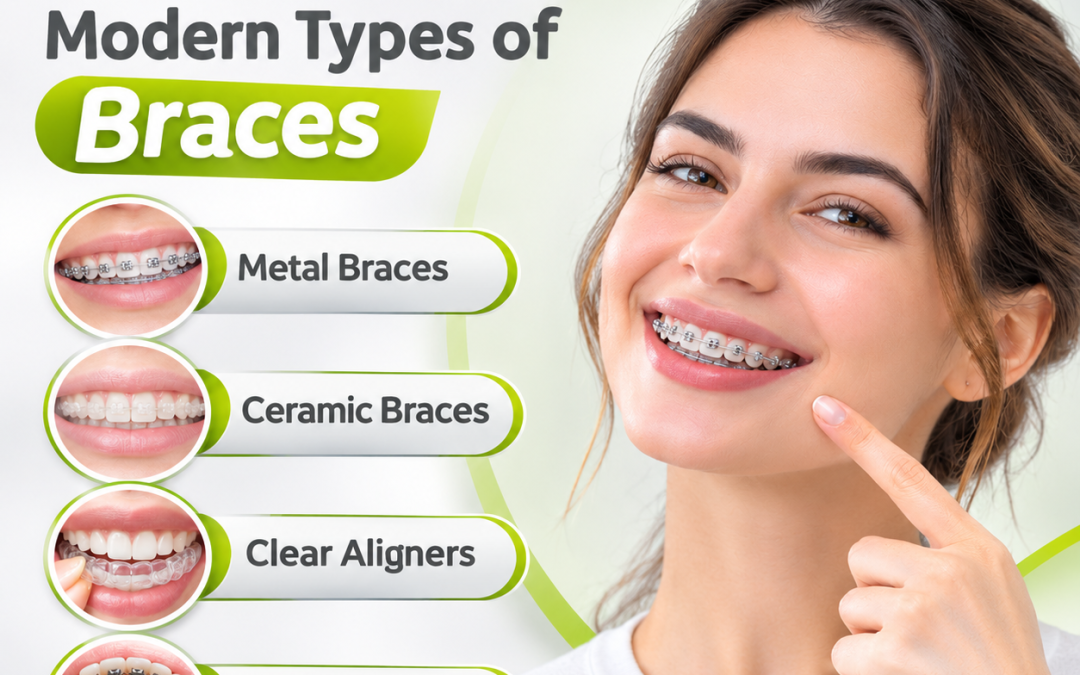
Modern types of braces offer various solutions for correcting crowded teeth, gaps, and bite problems. These treatments also help improve chewing function and smile alignment. However, orthodontic appliances differ in their mechanisms, appearance, and maintenance requirements. Some rely on metal brackets, while others use ceramic materials or removable clear aligners. Additionally, the nature of the dental problem, the patient’s age, and gum health influence appliance selection. Therefore, patients should not base their decisions solely on appearance or cost. Instead, they need a comprehensive examination and a treatment plan that considers tooth movement and jaw positioning. In this article, we explore the leading orthodontic technologies, explain their advantages and limitations, and discuss factors that help achieve stable results.
Modern Types of Braces and the Advantages of Each Technique
Modern orthodontic appliances differ in their designs and how they apply forces to teeth. Traditional metal braces use brackets and wires to gradually guide teeth into their desired positions. Ceramic braces, meanwhile, use tooth-colored brackets to make the appliance less noticeable. Additionally, orthodontists attach lingual braces behind the teeth, making them less visible when smiling. In contrast, removable clear aligners use a series of trays designed to move teeth according to a specific treatment plan. Some self-ligating bracket systems also feature special mechanisms that secure the wire without traditional elastic ligatures. However, no single technique suits every case. Therefore, orthodontists select appliances after evaluating bite alignment, crowding severity, and the required root movements. They also consider each patient’s ability to follow daily treatment instructions.
What Are the Most Common Modern Types of Braces?
Traditional Metal Braces
Traditional metal braces remain an important option for treating a wide range of dental alignment and bite problems. Orthodontists attach small brackets to the teeth and connect them with an orthodontic wire that gradually guides tooth movement. They can also adjust the forces and their directions during regular appointments according to the teeth’s response. Therefore, this appliance suits many cases involving severe crowding, rotated teeth, and gaps. Additionally, orthodontists can use supplementary attachments to improve tooth movement control. However, metal braces require careful cleaning around brackets and wires. Plaque accumulation may cause gum inflammation and white spots on tooth enamel. Furthermore, brackets may temporarily irritate the cheeks and lips. Therefore, orthodontic wax and consistent oral hygiene help reduce discomfort and improve the treatment experience.
Clear Ceramic Braces
Fixed ceramic braces offer a suitable option for people who prefer less noticeable brackets when speaking and smiling. Orthodontists use tooth-colored or translucent ceramic brackets and connect them with orthodontic wires. Therefore, these appliances work according to principles similar to conventional metal braces. Additionally, orthodontists can use them to treat many alignment and bite problems. However, ceramic brackets vary in their resistance to breakage and friction depending on their design and materials. Clear elastic ligatures may also become stained by certain foods and beverages. Ceramic brackets themselves generally offer better stain resistance. Furthermore, ceramic braces may cost more than metal braces. Therefore, patients should balance appearance, durability, and treatment requirements before choosing the most suitable appliance.
Removable Clear Aligners
Removable clear aligners use a series of plastic trays that gradually move teeth. Orthodontists design treatment plans based on clinical examinations and digital records. Patients then wear each set of aligners according to their orthodontist’s prescribed schedule. Many systems require approximately 20–22 hours of daily wear. Therefore, consistent compliance directly affects treatment progress. Additionally, patients can remove their aligners when eating and cleaning their teeth. However, they must reinsert them after cleaning their mouths according to the instructions. Orthodontists may also use small attachments on teeth to improve movement control. Nevertheless, complex cases may require additional appliances or fixed braces. Therefore, the transparent appearance does not necessarily mean that treatment is simpler or faster than other orthodontic options.
Lingual Braces
Orthodontists attach lingual brackets to the inner surfaces of teeth, away from direct view. Therefore, some patients choose this appliance when they want discreet fixed orthodontic treatment. Customized systems also allow specialists to design brackets and wires that accommodate individual dental anatomy. However, orthodontists need appropriate expertise in treatment planning and tooth movement control. Additionally, patients may experience tongue irritation or temporary changes in the pronunciation of certain sounds. They may also need more time to adapt to the appliance’s position. Furthermore, cleaning the inner tooth surfaces requires special attention because access can be difficult. Treatment costs also vary according to customization and case complexity. Therefore, orthodontists should evaluate oral space, bite alignment, and patient expectations before recommending this option.
Modern Types of Self-Ligating Braces and How They Differ from Traditional Appliances
Self-ligating brackets use an integrated mechanism to secure the orthodontic wire instead of conventional elastic ligatures. This mechanism may feature a small clip or door that opens and closes during adjustments. Therefore, certain systems may make wire changes easier during appointments. Additionally, friction and tooth movement control vary between different designs. However, scientific evidence does not consistently demonstrate that self-ligating brackets shorten treatment duration for all patients. They also do not guarantee reduced pain or eliminate the need for tooth extractions. Furthermore, treatment outcomes depend heavily on diagnosis, treatment planning, and clinical expertise. Therefore, patients should consider self-ligating brackets as one available fixed orthodontic option rather than a technology that automatically outperforms all alternatives.
Temporary Anchorage Devices and Their Role in Treating Complex Cases
Temporary anchorage devices, commonly known as TADs, help orthodontists control tooth movements that may be difficult to achieve using teeth alone. These small screws provide temporary anchorage when orthodontists place them in suitable areas of bone. Consequently, specialists can apply specific forces without relying entirely on neighboring teeth. These devices may help retract certain teeth or adjust their vertical positions. Additionally, they may reduce the need for patient cooperation with some external appliances. However, not every case requires these devices. Their use also demands careful evaluation of tooth roots, bone, and surrounding tissues. Some patients may experience localized inflammation or loosening of the screw. Therefore, orthodontists determine their suitability after assessing potential risks, benefits, and alternatives.
How to Choose Between Modern Types of Braces Based on Your Needs
Choosing an orthodontic appliance depends on several clinical and personal factors. Therefore, patients should begin with a comprehensive diagnosis rather than selecting an appliance based solely on its appearance. The main criteria orthodontists discuss with patients include:
-
Severity of crowding: Complex cases may require additional control over tooth and root movements.
-
Bite alignment: The relationship between the jaws and teeth influences treatment planning.
-
Aesthetic preferences: Some patients prefer ceramic brackets, lingual braces, or clear aligners.
-
Daily compliance: Removable aligners require consistent daily wear.
-
Gum health: Active gum inflammation requires evaluation and treatment before orthodontic tooth movement.
-
Budget: Treatment costs vary according to technology, case complexity, and follow-up duration.
-
Age and growth: Jaw development influences the timing of certain orthodontic interventions.
Orthodontic Treatment Duration and Factors Affecting Results
Orthodontic treatment duration varies according to the underlying problem and the movement required for each tooth. Some simple cases may take several months, while others require two years or longer. Additionally, patient age and the health of supporting tissues influence treatment planning and monitoring. Broken brackets or inconsistent aligner wear may also delay progress. Furthermore, increasing orthodontic force does not necessarily accelerate tooth movement. Inappropriate forces may negatively affect tooth roots and surrounding tissues. Therefore, orthodontists schedule follow-up appointments according to appliance type and the teeth’s response. Patients may also need an additional stage to refine bite alignment. Ultimately, treatment quality depends on precise tooth movement and stability rather than simply achieving the shortest possible treatment duration.
Modern Types of Braces at Expert Dental Center in Qatar
Expert Dental Center in Qatar provides orthodontic services that draw on its doctors’ experience and skills in diagnosing and treating dental alignment and bite problems. Among its specialists, Dr. Emad Rostom, Senior Consultant Orthodontist, stands out with more than 28 years of professional experience in dentistry and advanced specialization in orthodontics. He has extensive experience with metal braces, ceramic braces, clear aligners, and lingual orthodontics, helping him select the most appropriate technique for each patient. Additionally, Dr. Emad applies his expertise in precise treatment planning and tooth movement analysis to balance function and aesthetics. The center’s doctors also carefully monitor treatment stages and regularly assess how teeth respond. Therefore, the center combines clinical expertise with modern technologies to provide personalized orthodontic solutions that help patients achieve healthy, well-aligned smiles.
Expert Dental Center in Qatar: International Expertise and Modern Technologies
Expert Dental Center in Qatar combines international dental expertise with advanced technologies to provide comprehensive oral and dental care. The center brings together a team of specialized dental professionals with academic qualifications from Germany, the United States, Australia, and Qatar. Furthermore, the team offers extensive experience in many dental services like dental implants, orthodontics, cosmetic dentistry, oral surgery, and pediatric dentistry.
In addition, the center utilizes advanced dental technologies, including 3D intraoral scanning, digital smile design, 3D dental imaging, dental microscopy, and clear aligner orthodontics. Moreover, its multidisciplinary approach allows patients to receive comprehensive dental assessments and personalized treatment plans tailored to their individual needs.
The dental team also prioritizes clear communication, helping patients understand their treatment options and make informed decisions. Additionally, patients can communicate with dental professionals in multiple languages, including Arabic, English, German, Spanish, and Swedish.
Ultimately, Expert Dental Center combines academic excellence, clinical expertise, and modern dental technology to deliver comprehensive dental care that focuses on oral health, functionality, and the natural aesthetics of every smile.
If you would like to book an appointment additional consultations or wish to explore advanced treatment options, you can learn more about Expert Dental Center in Qatar by visiting the center’s location in Doha, following its YouTube channel, checking its TikTok and Instagram accounts, or visiting the official website online.
Conclusion
Understanding modern types of braces helps patients explore the available options for correcting tooth alignment and improving bite function. Traditional metal braces provide effective movement control in many cases, while ceramic braces offer a less noticeable appearance. Additionally, clear aligners provide daily flexibility but require consistent compliance. Lingual braces also offer a discreet fixed option by positioning brackets behind the teeth. Furthermore, digital technologies and temporary anchorage devices support certain complex treatment plans. However, no single appliance guarantees faster or better results for every patient. Therefore, patients should choose treatment based on a specialist’s diagnosis and a plan that protects dental and gum health. Consistent oral hygiene, regular follow-up appointments, and proper retainer use also help maintain results. Ultimately, successful orthodontic treatment combines function, aesthetics, and long-term stability.