

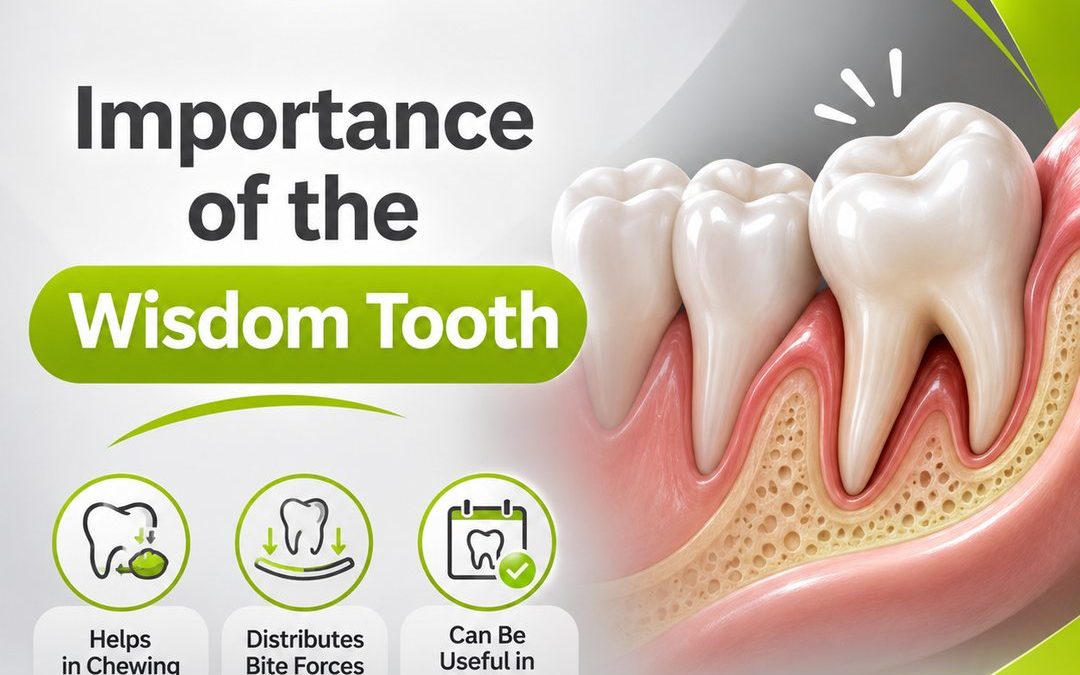
Wisdom teeth usually emerge during the later stages of permanent tooth development, typically between the ages of 17 and 25. They sit at the back of the jaw, behind the other molars, and dentists refer to them as third molars. However, many people believe these teeth serve no important function. In reality, their value depends on their position, eruption pattern, and the condition of neighboring teeth. The importance of wisdom teeth becomes evident when they erupt normally and contribute to chewing without causing dental problems. Additionally, they may offer benefits in certain future treatment plans. Conversely, impacted wisdom teeth can cause infections or damage adjacent teeth. Therefore, dentists cannot recommend extraction based solely on the presence of a wisdom tooth. Instead, they need an appropriate clinical and radiographic assessment. This article explores wisdom tooth functions, the benefits of preserving them, impaction risks, and the circumstances that require removal.
The Importance of Wisdom Teeth in Chewing and Distributing Bite Forces
A healthy wisdom tooth performs functions similar to those of other molars when it erupts into a suitable position. Its chewing surfaces help break down food during mastication. Additionally, it can contribute to distributing biting forces when it contacts a functional opposing tooth. However, its actual contribution varies according to its size, position, and occlusal relationships. Some individuals benefit from its chewing function, while others have wisdom teeth that contribute little to mastication. Furthermore, most people can chew efficiently without their wisdom teeth. Therefore, these teeth are not essential for maintaining normal jaw function. Nevertheless, dentists may prefer preserving healthy wisdom teeth that function properly and remain easy to clean. Proper alignment within the dental arch can also reduce food accumulation around the tooth. Consequently, evaluating its usefulness requires assessing its actual function rather than simply considering its name or position.
The Importance of Wisdom Teeth When Adjacent Molars Are Missing
A wisdom tooth may become particularly valuable when a patient loses a neighboring molar. For example, dentists may consider incorporating it into a specific restorative treatment plan. In certain cases, orthodontists can move a third molar forward after the loss of a second molar. Additionally, clinicians may evaluate whether a suitable wisdom tooth can replace another missing tooth through transplantation. Dentists call this procedure tooth autotransplantation. However, these options do not suit every patient. Successful treatment depends on root anatomy, root development, and the health of surrounding bone and gum tissues. Furthermore, tooth transplantation requires specialist assessment and appropriate clinical expertise. Conversely, deeply impacted teeth or those with complex roots may present additional challenges. Therefore, patients should not consider wisdom teeth guaranteed replacements for missing molars. Instead, they represent potential treatment options under specific clinical circumstances.
The Importance of Wisdom Teeth in Long-Term Dental Treatment Planning
The value of wisdom teeth extends beyond their immediate contribution to chewing. Their presence may influence future dental decisions, particularly orthodontic treatment and tooth replacement planning. Therefore, dentists examine their position and relationship with adjacent teeth before recommending extraction. They also evaluate whether partially developed wisdom teeth may erupt normally. In certain cases, clinicians may preserve these teeth when they anticipate a useful future function. However, no dentist can guarantee that a wisdom teeth will become beneficial later. Additionally, potential future value does not justify retaining a tooth that already causes significant disease. Conversely, delaying treatment for an affected wisdom tooth may complicate subsequent procedures. Therefore, clinicians balance anticipated benefits against existing risks. Regular follow-up appointments also allow dentists to reconsider treatment decisions when the tooth or surrounding structures change.
Why Do Wisdom Teeth Erupt Later Than Other Teeth?
Wisdom teeth differ from most permanent teeth in their eruption timing. Other permanent teeth generally emerge during childhood and early adolescence. However, third molars usually appear during late adolescence or early adulthood. This timing relates to crown formation, root development, and jaw growth. Nevertheless, eruption schedules vary considerably between individuals. Some people develop visible wisdom teeth earlier, while others experience delayed eruption or complete impaction. Additionally, certain individuals never develop wisdom teeth because of natural genetic variation. Importantly, delayed eruption does not necessarily indicate a dental problem. Therefore, dentists use clinical examinations and radiographic imaging when specific findings justify further assessment. They also evaluate the tooth’s eruption direction and the available space behind the second molar. Consequently, clinicians can distinguish normal developmental variation from impaction that requires monitoring.
When Do Wisdom Teeth Become a Dental Problem?
Wisdom teeth may erupt normally without causing symptoms. However, insufficient space or partial eruption can contribute to conditions requiring professional evaluation. Therefore, patients should recognize the following warning signs:
-
Recurrent gum inflammation: Bacteria may accumulate around partially erupted wisdom teeth, causing inflammation of the surrounding tissues.
-
Tooth decay: Difficult-to-reach posterior surfaces may encourage plaque accumulation and cavity development.
-
Damage to adjacent molars: The position of a wisdom tooth may contribute to decay or root damage affecting the second molar.
-
Pain and swelling: These symptoms may indicate inflammation or another dental condition requiring diagnosis.
-
Difficulty opening the mouth: Severe inflammation around impacted wisdom teeth may restrict jaw movement.
-
Cyst formation: Certain unerupted teeth may develop associated cystic lesions, although these complications are uncommon.
-
Persistent food trapping: Repeated food accumulation can irritate the gums and complicate oral hygiene.
Can Wisdom Teeth Cause Crowding of the Front Teeth?
Many people believe emerging wisdom teeth push other teeth forward and cause crowding. Consequently, some request extraction to protect previous orthodontic results. However, scientific evidence does not support identifying wisdom teeth as the sole direct cause of anterior dental crowding. Several factors influence tooth alignment as people age. These include jaw growth, changes in occlusion, and the stability of supporting tissues. Additionally, minor changes in front tooth alignment can occur in people who never develop wisdom teeth. Furthermore, removing third molars does not guarantee that future crowding will not occur. Therefore, dentists generally should not recommend routine extraction solely to prevent anterior crowding. Instead, they assess other indications, including decay, infection, and potential effects on orthodontic treatment. Ultimately, appropriate retainers and orthodontic follow-up help maintain treatment outcomes according to individualized plans.
How Do Dentists Determine Whether Wisdom Teeth Should Be Preserved?
Wisdom tooth evaluation begins with reviewing symptoms, medical history, and clinical findings. Next, dentists examine tooth alignment and the extent of eruption. They also inspect surrounding gum tissues for inflammation or decay. Additionally, clinicians assess whether patients can adequately clean the area using a toothbrush and appropriate interdental tools. In certain cases, dental X-rays help determine the relationship between the wisdom tooth, jawbone, and neighboring teeth. For more complex situations, dentists may recommend cone-beam computed tomography when its findings could influence treatment decisions. However, not every patient requires three-dimensional imaging. Furthermore, surgeons may evaluate the relationship between lower wisdom tooth roots and the inferior alveolar nerve before extraction. Therefore, preservation decisions depend on tooth health, function, and the feasibility of safe monitoring. Dentists also discuss patient preferences and potential risks.
Differences Between Healthy, Partially Impacted, and Fully Impacted Wisdom Teeth
Wisdom teeth present different clinical conditions depending on their eruption direction and position within the mouth. A healthy wisdom tooth erupts into a position that supports chewing and cleaning without harming neighboring teeth. In contrast, a partially impacted wisdom tooth emerges incompletely, leaving gum tissue covering part of its crown. This arrangement may allow bacteria to accumulate beneath the gum flap. Consequently, patients may experience recurrent pericoronitis. Meanwhile, a fully impacted wisdom tooth remains within the jawbone or beneath surrounding tissues without emerging into the mouth. However, complete impaction does not automatically cause disease. Some individuals remain free of symptoms and pathological changes for extended periods. Therefore, dentists do not base treatment decisions solely on the degree of impaction. Instead, they consider radiographic findings, clinical conditions, and potential complications. They also establish appropriate monitoring plans when preservation remains suitable.
When Is Wisdom Tooth Extraction Better Than Preservation?
Extraction becomes appropriate when a wisdom tooth causes problems that conservative treatment cannot resolve effectively. For example, dentists may recommend removal when patients experience recurrent pericoronitis. Additionally, deep decay that prevents reliable restoration may justify extraction. Damage affecting the adjacent second molar may also require surgical intervention. However, professional recommendations differ regarding routine removal of impacted wisdom teeth without disease. Clinical decisions depend on individual risk assessments and available scientific evidence. Therefore, dentists should discuss the benefits of monitoring compared with preventive extraction when indications remain uncertain. Surgeons also consider patient age, root development, and proximity to important nerves. Ultimately, shared decision-making between the dentist and patient supports appropriate treatment while avoiding unnecessary intervention.
Wisdom Tooth Extraction Complications and How to Reduce Risks
Wisdom tooth extraction is a common dental procedure, but it carries potential risks like other surgical interventions. Patients may experience pain and swelling during the first few days. Additionally, mild bleeding or temporary difficulty opening the mouth may occur. Another possible complication is dry socket, also known as alveolar osteitis. This condition can develop when the extraction site’s blood clot breaks down or disappears prematurely. It may cause significant pain several days after surgery. Furthermore, extraction of certain lower wisdom teeth can affect nearby nerves. This may produce temporary or, rarely, persistent changes in sensation affecting the lip, chin, or tongue. Upper wisdom tooth removal may also involve sinus-related complications in selected cases. Therefore, surgeons review appropriate imaging before surgery and provide personalized postoperative instructions. Fever, heavy bleeding, or increasing swelling requires urgent medical assessment.
How to Care for Wisdom Teeth and Prevent Cavities and Gum Infections
Wisdom teeth require regular care when they erupt into positions suitable for preservation. Therefore, patients should carefully clean their posterior surfaces using an appropriate toothbrush. Additionally, interdental cleaning helps reduce plaque accumulation between second and third molars. However, certain areas may remain difficult to access because of tooth position or restricted mouth opening. In these situations, dentists can recommend individualized cleaning techniques. Furthermore, fluoride toothpaste helps reduce the risk of dental cavities. Patients should also limit frequent consumption of sugary snacks and beverages. Importantly, recurrent inflammation, unusual odors, or persistent cleaning difficulties warrant professional evaluation. Nevertheless, home care alone may not adequately protect every partially impacted wisdom tooth. Therefore, dentists assess the need for additional treatment when problems continue despite improved oral hygiene.
Wisdom Tooth Assessment at Expert Dental Center in Qatar
Expert Dental Center in Qatar combines international dental expertise with advanced technologies to provide comprehensive oral and dental care. The center brings together a team of specialized dental professionals with academic qualifications from Germany, the United States, Australia, and Qatar. Furthermore, the team offers extensive experience in many dental services like dental implants, orthodontics, cosmetic dentistry, oral surgery, and pediatric dentistry.
In addition, the center utilizes advanced dental technologies, including 3D intraoral scanning, digital smile design, 3D dental imaging, dental microscopy, and clear aligner orthodontics. Moreover, its multidisciplinary approach allows patients to receive comprehensive dental assessments and personalized treatment plans tailored to their individual needs.
The dental team also prioritizes clear communication, helping patients understand their treatment options and make informed decisions. Additionally, patients can communicate with dental professionals in multiple languages, including Arabic, English, German, Spanish, and Swedish.
Ultimately, Expert Dental Center combines academic excellence, clinical expertise, and modern dental technology to deliver comprehensive dental care that focuses on oral health, functionality, and the natural aesthetics of every smile.
If you would like to book an appointment additional consultations or wish to explore advanced treatment options, you can learn more about Expert Dental Center in Qatar by visiting the center’s location in Doha, following its YouTube channel, checking its TikTok and Instagram accounts, or visiting the official website online.
Conclusion
Wisdom teeth do not automatically represent a health problem simply because they emerge at the back of the jaw. They can contribute to normal chewing when they erupt properly and contact suitable opposing teeth. Additionally, they may offer future treatment benefits in selected cases. However, impacted or partially erupted wisdom teeth can cause inflammation and damage neighboring teeth. Therefore, patients should not base extraction decisions solely on age or the presence of a third molar. Instead, they need clinical examination and radiographic assessment when necessary. Understanding the importance of wisdom teeth also helps distinguish cases that benefit from preservation from those requiring intervention. Furthermore, consistent oral hygiene and regular dental monitoring support early detection of changes. Ultimately, dentists should balance tooth function, retention risks, and potential extraction complications. This approach helps patients make informed decisions that protect long-term oral health.